

It was a bloodbath for the Republicans this midterm cycle. Let’s call it a blue bath. It was also a sobering reckoning for a bombastic President. Trump worked like crazy during this election season, seeking to help Republicans maintain their majorities in the House and Senate (the contrast between his energy level and Biden’s is stark). In the end, the packed rallies across the country did not materialize the votes for Republicans that had propelled Trump into office in 2016 and 2024.
Not only was he not successful, but Republicans lost bigly. Heretic James Talerico (and I don’t use the term lightly) won the Senate race in Texas, which went blue for the first time in decades. Muslim and Democratic Socialist Abdul Al-Sayed won the Senate race in Michigan.
Is this a Chicken Little Moment? Is the sky falling?

First of all, here’s some historical perspective for how these mid-term election losses go for the President’s party - whether Democrat or Republican:
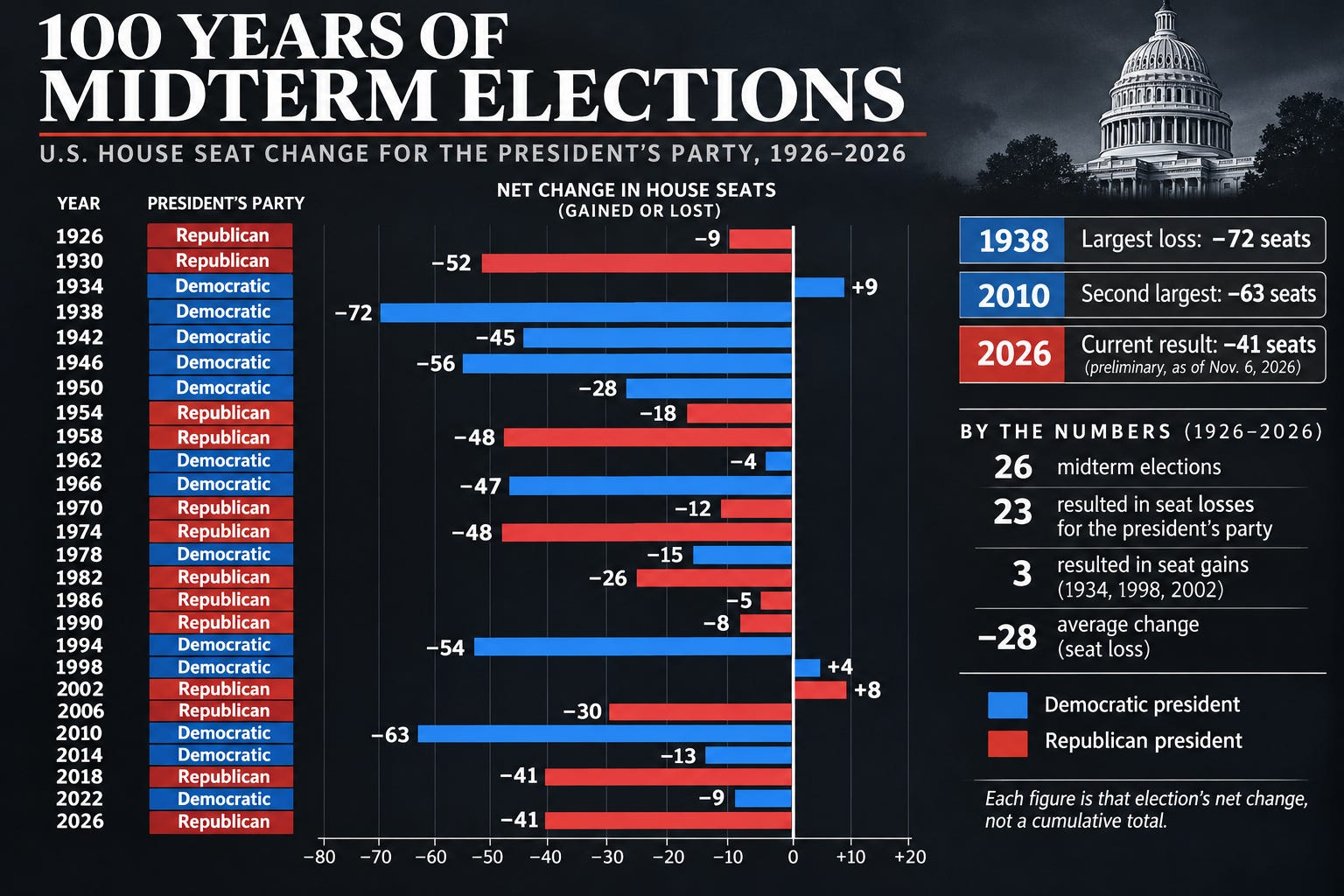
The following image has been circulating on the webs. I don’t know who initially made it, but it’s been corrected for accuracy.
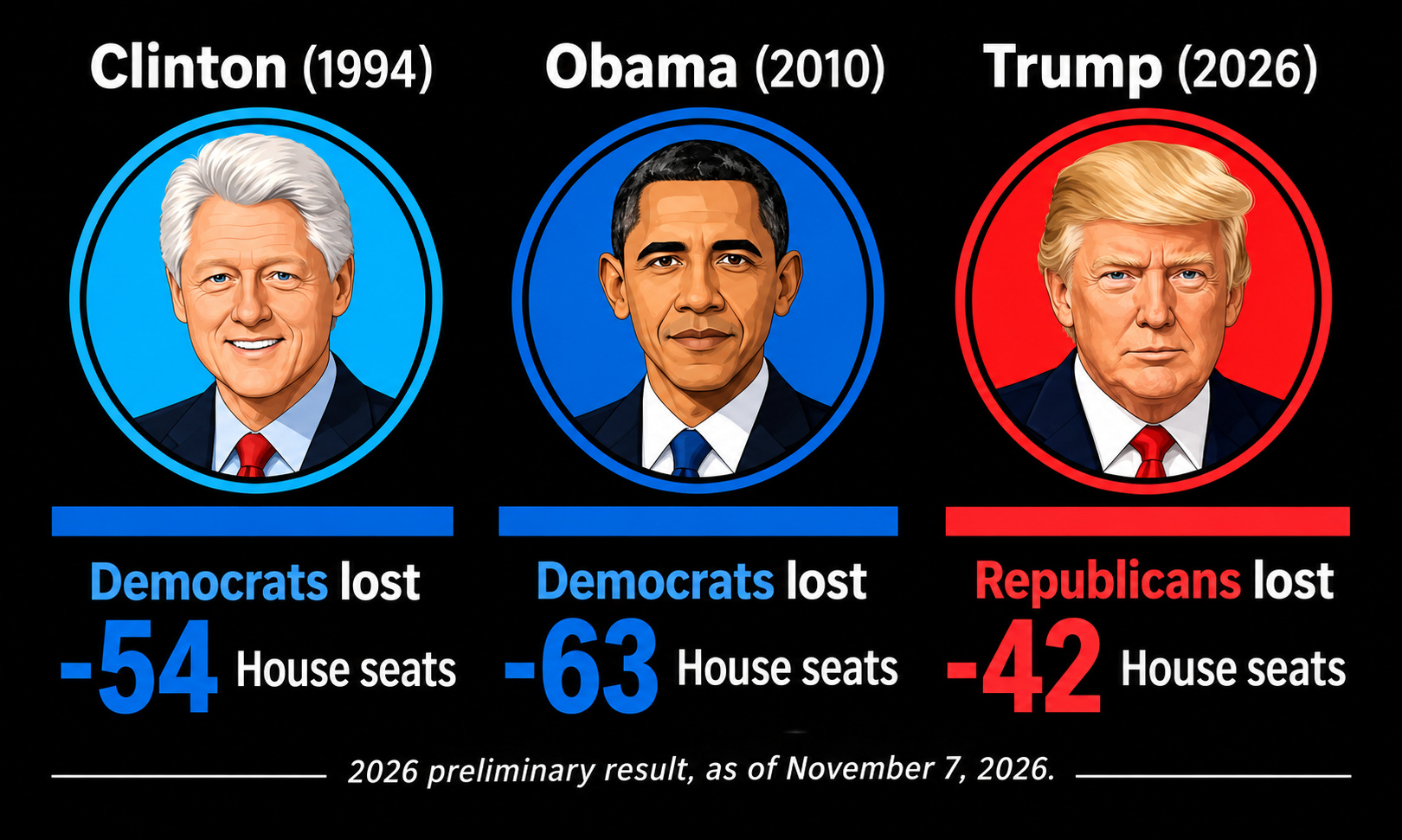
For those of us who vote Republican out of necessity and conviction rather than identifying politically with Republican politicians and personalities, this election stung. This wasn’t just a corrective election. The Democrats themselves are in disarray, with Communist/Socialist candidates interspersed with Islamists winning offices and seeking to jerk the Dems further left than progressives want. This election portends difficult consequences for a democratic republic seeking to maintain its founders’ vision.
Who’s to blame for the deep divide?
Trump is an inflammatory personality. No one disputes that. What folks younger than 30 fail to remember is that Obama was just as (some would argue more) divisive to our nation. In other words, Trump isn’t the cause of our current political polarization. He hasn’t hesitated to pour gas onto the conflagration.
I still point to Obama and Congress shamelessly pushing through a massive expansion of the government into the U.S. healthcare system (known as Obamacare) in a power move that corrupted the spirit of compromise which should embody politics. That legislation and partisan philosophical push was an enormous expansion of federal involvement in the financing, regulation, and distribution of health insurance. While making insurance available and affordable for some, it increased insurance costs for most. I believe it made our healthcare system worse, and we are still, literally, paying for it.
Its passage was a significant departure from the spirit of compromise that should characterize representative government. Democrats ultimately pushed through an enormous expansion of federal involvement in health care without a single Republican vote in the Senate, relying on controversial legislative maneuvering and a series of politically expedient concessions to secure passage.
It set the stage for our modern hyper-partisanship which seeks to rule by power rather than representation. The governing philosophy became increasingly transactional: secure the votes, employ whatever procedural advantages are available, and impose your agenda while you have the power to do so.1 That approach may produce legislative victories, but it comes at a cost. It diminishes the incentive to persuade, weakens the expectation of good-faith compromise, and reinforces the belief that winning political power is more important than representing the broader interests of the country. Eventually, each side learns to play by the same rules, and the cycle becomes increasingly difficult to break.
The days ahead
We saw this on Wednesday after the elections. That’s when prominent Democrats began declaring their Revenge Tour. They called for the impeachment of President Trump and the prosecution of his allies, whether political, familial or corporate. Exit polls clearly showed that Americans wanted an end to the Iran War and someone to address affordability issues.
We can expect the Democrats to lead us again in unhappy goose chases down impeachment trials while reviving the culture wars on issues like transgenderism, abortion and gender as a whole. This is not governance. This is an attempt to remake the American experiment and transform the fundamental nature of politic into socialism.
I would argue that something much more sinister is at work as well. This is a combination of religion masquerading as political philosophy. What we are seeing is an alliance of Islam and Communism/Socialism. Between those two religions, Islamists will ultimately prevail, because they will do and say what they need to in order to gain power. When Islamists gain power, humanity suffers. Make no mistake. If Islamists gain power in the U.S., your religious liberty is at stake.2 Look at Iran, Afghanistan and other examples of modern Islamist states.
What about the Christian vote?
It’s difficult to determine, but one estimate is approximately 6 million fewer evangelicals voted in this year’s midterm than in 2022, which is a reduction of 22%. In many of the closer races around the country, the abstentia of Christian voters may have indeed influenced the outcome of elections. A reasonable case could be made in at least six states that the decline in Christian voter turnout led to Democrat victories: Louisiana, South Carolina, Iowa and Kansas. (Alaska and Mississippi have yet to be called since they are so close).
How should Jesus followers respond to the new realities (which are old realities) in the political landscape?
Nothing has changed for the follower of Jesus. Not one thing. Leaders are changed as often, it seems, as diapers (and some are just as dirty). Yet, our Leader is Jesus. He is unstained, unperturbed, unchanging and Wonderful. Jesus is Sovereign.
Christians must first rest in Him. Our mission has not changed. We must continue to “seek first His kingdom and His righteousness.” (Matthew 6:33) Followers of Jesus, we must share the gospel of hope, salvation, truth and grace with all people. Our mission is to “make disciples of all nations.” (Matthew 28:19)
That has not changed.
Seek first His kingdom
Seek first His righteousness (the two seek’s are intertwined)
Make disciples of/in all the nations
These imperatives call us not to quietness, cowardice or resignation. Regardless of who is in office, we must engage with our culture with truth and grace. Jesus has made us both salt and light.
We must boldly go where the gospel has not gone before. That going is both spatial (give, send, and go to places with the gospel) and personal (we as individuals must be joyfully bold and firmly gracious in conversations).
Be ready. Expect the Left to seek to attempt to cow Christians into silence and shame about our biblical convictions related to cultural issues.3 Do not go back to the dark days of 2019-2024ish. Evil suffocated the world during those years. Those years were a global move of satanic power that still exceeds our understanding. Do not allow the forces of culture to silence your gospel convictions and voice.
Get involved in local politics. These are the days to mobilize in your churches and communities in preparation for the next election season. Run for school board, town council, boards of supervisors, etc. Influence where you live first.
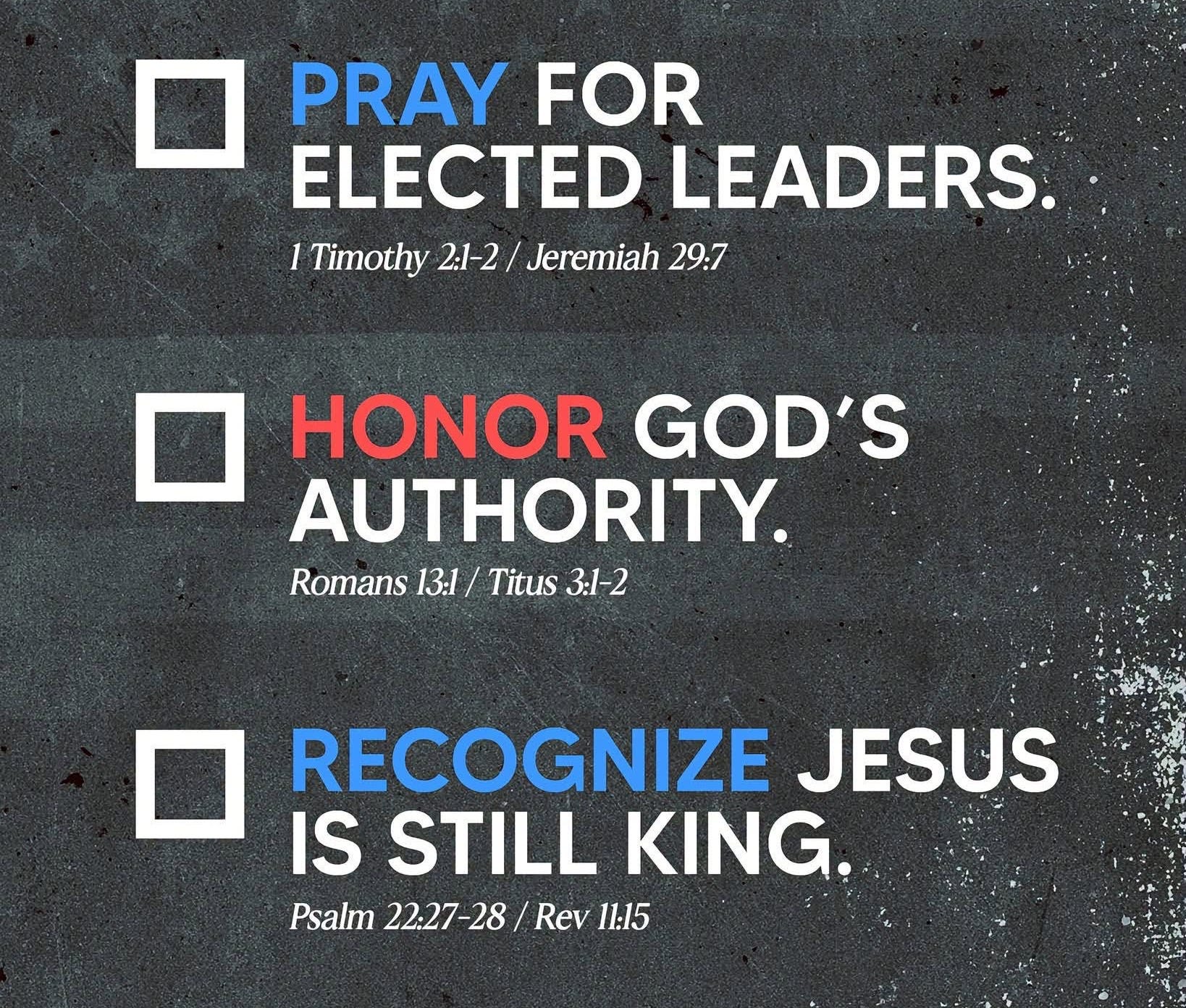
Above all, pray consistently for those in elected positions. This is an obedience issue. We are commanded to pray for those in government.
Before he became President, Abraham Lincoln gave a speech at a Republican banquet in Chicago in 1854. He said:
“Our government rests in public opinion. Whoever can change public opinion, can change the government, practically just so much.”4
Believers, we have a lot of work to do. It won’t be done by noninvolvement. May we change public opinion with our reasonableness, our charity, our firm convictions, and demonstrations of faithful lives. John Stott said, “We are not powerless. I’m afraid what we are, rather, is often lazy and shortsighted and unbelieving and disobedient to the commission of Jesus.”
The manner in which Jesus followers dialogue must be firm but gentle. We must not shy away from heated arguments. Rather, we control their temperature with shrewd grace and thoughtfulness. The apostle Paul said, “Let your reasonableness be known to everyone.” (Philippians 4:5) “Reasonableness” can also be translated as “gentleness.” Christian gentleness is not being a pushover. It means salting our responses with truth and grace.
In his book, Civility from Above, Richard Mouw quotes Martin Marty as saying, “Many people these days who have strong convictions are not very civil; and many people who are civil don’t have very strong convictions.”
“Do not fear them or be intimidated, but in your hearts regard Christ the Lord as holy, ready at any time to give a defense to anyone who asks you for a reason for the hope that is in you. Yet do this with gentleness and reverence…” (1 Peter 3:14-16)
Let us get ready, get involved, get praying, and let us be people of convicted civility.
Back in 2012, I wrote What politicians should learn from pastors. That article examines what would happen in a church if a pastor attempted to lead it like politicians are “leading” our country.
LGBTQ, sexuality and gender issues, abortion, “scientific” fallacies, and bowing to supposed “experts.”
Speech at a Republican Banquet, Chicago, Illinois, by Abraham Lincoln (Chicago, Illinois; December 10, 1856)