

Everyone sees it. Few want to acknowledge it. It’s not like the sudden voracious and disastrous flooding in Nepal that happened so fast that thousands were swept away in flood water. The steady encroachment of Islam and its evil doctrines are more like a leak in a water line.
A friend recently returned home after being gone a month to discover that a small leak in his refrigerator’s water line had, over the time he’d been gone, ruined not only his kitchen floor but had leaked to the floor below and ruined flooring there as well. That steady, unrelenting trickle, when not fixed, causes great damage.
Back in 2014 I wrote Can one be neutral toward Islam? As I reread that post recently, I was struck about the dangerous slow leak of Islam into western society in the past 12 years. In some cases, it’s appeared to be organized and intentional.1
Twelve years ago, I wrote:
…Is ISIS’ brand of Islam truly radical?
In the first quarter of the 20th century, Christian evangelicals arose in the United States to attempt to steer Christianity in the U.S. away from perceived liberalism. In Christian universities, there were faculty members denying basic tenets of the Bible’s teachings, and it seemed that historic Christian beliefs were being discarded daily. The movement to recapture a drifting faith was named as fundamentalism, and the term fundamentalist was used derogatorily by many who would have preferred that the church in America jettison its holiness and belief in the truth of the Bible. (By the way, it was a bloodless movement.)
I believe that instead of labeling what we’re seeing in ISIS, the Taliban, Al-Qaeda, Boko Haram, the Muslim Brotherhood and other militant expressions of Islam is not radical. It’s fundamental to the teachings of the religion. What we’re seeing is Islamic fundamentalism.
Today’s World
Today there is an underlying problem in western culture: there is a conflation of Islam and Christianity in the minds of the irreligious and uninformed. People often treat Christianity and Islam as interchangeable examples of the same category - “religion.” They are ignorant to each religion’s competing truth claims. People assume they are simply different but equally legitimate expressions of religious faith. That false perspective obscures the fact that Christianity makes an exclusive claim about Jesus Christ, while Islam explicitly rejects central Christian claims about Jesus, the cross, and salvation.
Before I unpack this, I want to be clear: I’m not writing to be hostile toward Muslims. In America, we have a religious equality under law, but this does not result in theological equality before God. The First Amendment protects Muslims' freedom to worship, but it does not require anyone to believe that Islam and Christianity are equally true.
My ultimate point here is that the benefits and consequences of Christianity and Islam in the world are not comparable. No one can pretend that the competing truth claims of these two religions are the same. My premise is that Christianity far exceeds Islam as a blessing and benefit to the peoples of the world. I would hope that secular Muslims would thoughtfully weigh the competing truth claims and prayerfully take steps toward a faith that seeks understanding in the truths of Christianity.
Historical Perspective
Exactly when did Christians begin viewing Islam (and other religions) with tolerance and at times, indifference? In his book, Saving Faith: Making Religious Pluralism an American Value at the Dawn of the Secular Age, David Mislin offers the perspective that Protestant liberals, in the late 19th and early 20th centuries began to defend the right to worship for other religions. They believed that if all religions didn’t have freedom of worship, their worship might one day be endangered. This defense of freedom of religion did not take into account the difference in blessing and benefit. In other words, all religions are not created equal.
Here’s an except from the book’s summary:
Between 1875 and 1925, liberal Protestant leaders abandoned religious exclusivism and leveraged their considerable cultural influence to push others to do the same. This reorientation came about as an ever-growing group of Americans found their religious faith under attack on social, intellectual, and political fronts. A new generation of outspoken agnostics assailed the very foundation of belief, while noted intellectuals embraced novel spiritual practices and claimed that Protestant Christianity had outlived its usefulness. Faced with these grave challenges, Protestant clergy and their allies realized that the successful defense of religion against secularism required a defense of all religious traditions. They affirmed the social value - and ultimately the religious truth - of Catholicism, Judaism, Hinduism, Buddhism, and Islam. They also came to view doubt and uncertainty as expressions of faith.2
In God We Trust
Our currency declares, “In God we trust.” Our Pledge of Allegiance contains the phrase “one Nation under God.” “Under God” was added by Congress in 1954, during the Eisenhower administration.
Ironically, a Baptist minister wrote the first pledge of allegiance. His name was Francis Bellamy.3
In the Declaration of Independence (1776), we see God mentioned explicitly and implicitly as Creator:
“the Laws of Nature and of Nature’s God”
“all men are created equal”
rights endowed by their “Creator”
“the protection of divine Providence”
At George Washington’s first inaugural address in 1789, the first President spoke of the “Almighty Being who rules over the universe” and the “Invisible Hand which conducts the affairs of men.” He called upon God to guide the new government and people. Thirty years later, President James Madison gave a Thanksgiving Proclamation in 1815 and referred to “Almighty God,” “His kind Providence,” and God’s providential direction of the American people toward independence and self-government. The overwhelming majority of Presidential inaugurations have also included the newly-elected president placing their hand on a Bible when taking the oath of office.
Even in our nation’s architecture, we see evidences of biblical Christianity. The Supreme Court building itself contains extensive biblical imagery. Moses appears among the great historical lawgivers on the courtroom’s south frieze, holding the Ten Commandments in Hebrew. The Jefferson Building (Library of Congress) contains a statue of Moses holding the Ten Commandments alongside the Apostle Paul dating back to 1897.
Back in 1791, George Washington and architect Pierre L’Enfant conceived a church building in the nation’s capitol to be a “great church for national purposes.” That vision was realized when Washington’s National Cathedral began construction in 1907. The foundation stone was laid in the presence of President Theodore Roosevelt and about 10,000 people. The stone came from a field near Bethlehem and was inscribed, “The Word was made flesh, and dwelt among us” (John 1:14).
While these examples are not evidence that the Constitution established Christianity as a national religion, they do provide foundation for the reality and fact that our nation has a distinct Christian cultural and historical foundation.
The God of America is not Allah
Could the “God” references in America’s history, founding documents and architecture be remotely interpreted as a generic god and so include Allah as well? My contention is not at all. It matters, because we must ask as a nation which “God” are we under? Which God do we trust? Can the God of Christianity be equated with the Allah of Islam?
Consider the following distinctions:
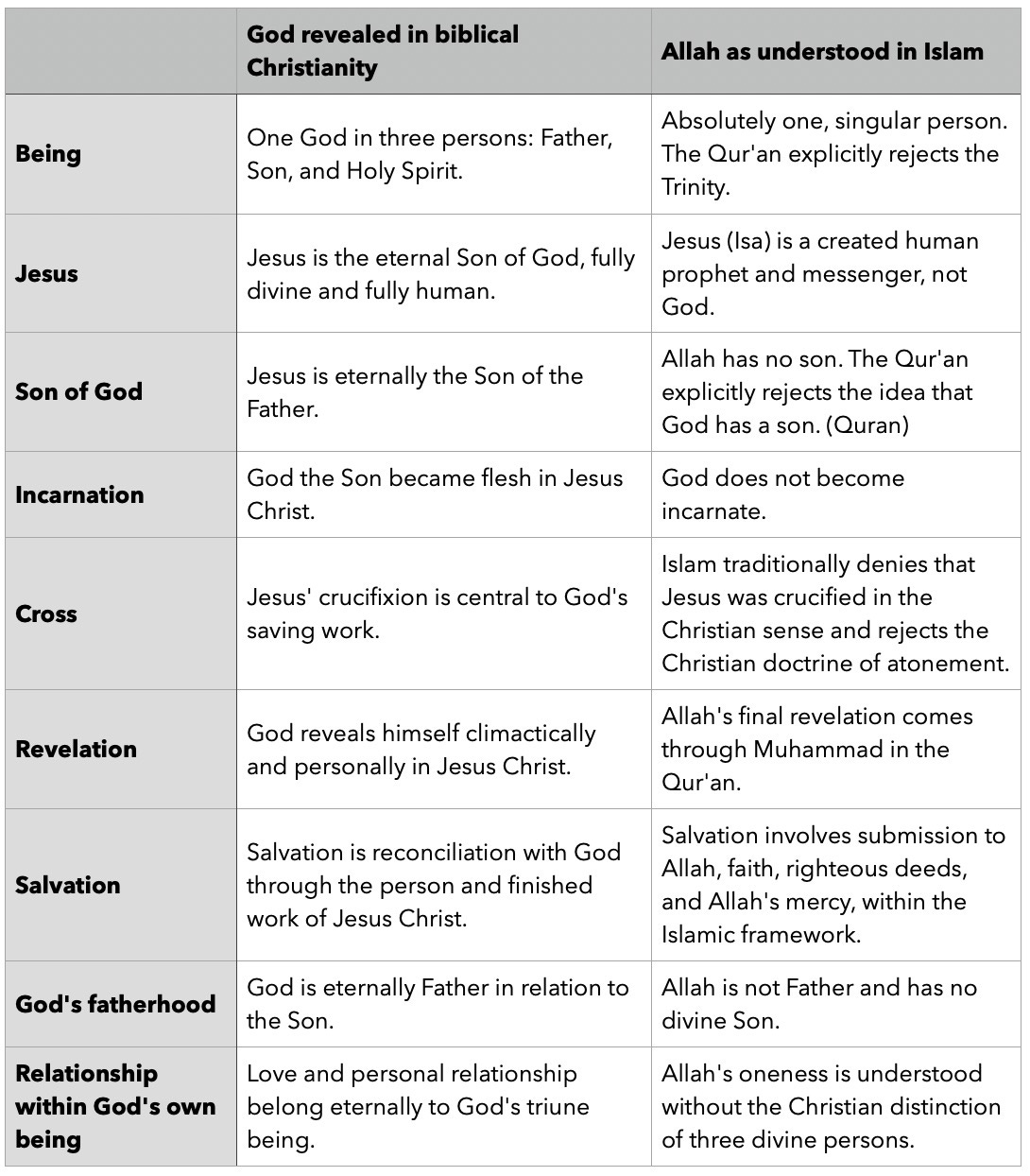
So while Christianity and Islam use overlapping language about “God,” they do not mean the same thing by God. The founding of America both implicitly and explicitly acknowledged the God of Christianity.
Islam vigorously denies the Christian confession that Jesus is the divine Son of God, while Christianity clearly identifies Jesus as God the Son incarnate. This core doctrinal disagreement between the two reaches the very identity and nature of God.
This means that Muslims must recognize that while they have a legal right to worship Allah in America, America as a nation was founded by people with Christian doctrinal realities influencing them. The tension between the two religions is not imagined. When secularists or the religiously ignorant increasingly treat Islam’s understanding of God as interchangeable with Christianity’s, it promotes a blend that is fundamentally incompatible and heretical to both religions.
The disturbing reality of Islamic violence against other religions
We must consider also the benefits and blessings of each religion. What are their outcomes? Since I wrote my entry 12 years ago, Islam has not mellowed. Throughout its history, it has warred against other religions. In the past decade, we have only seen more Islamic-inspired terror attacks, while in the same time period, no true biblical Christianity-inspired terror attacks.
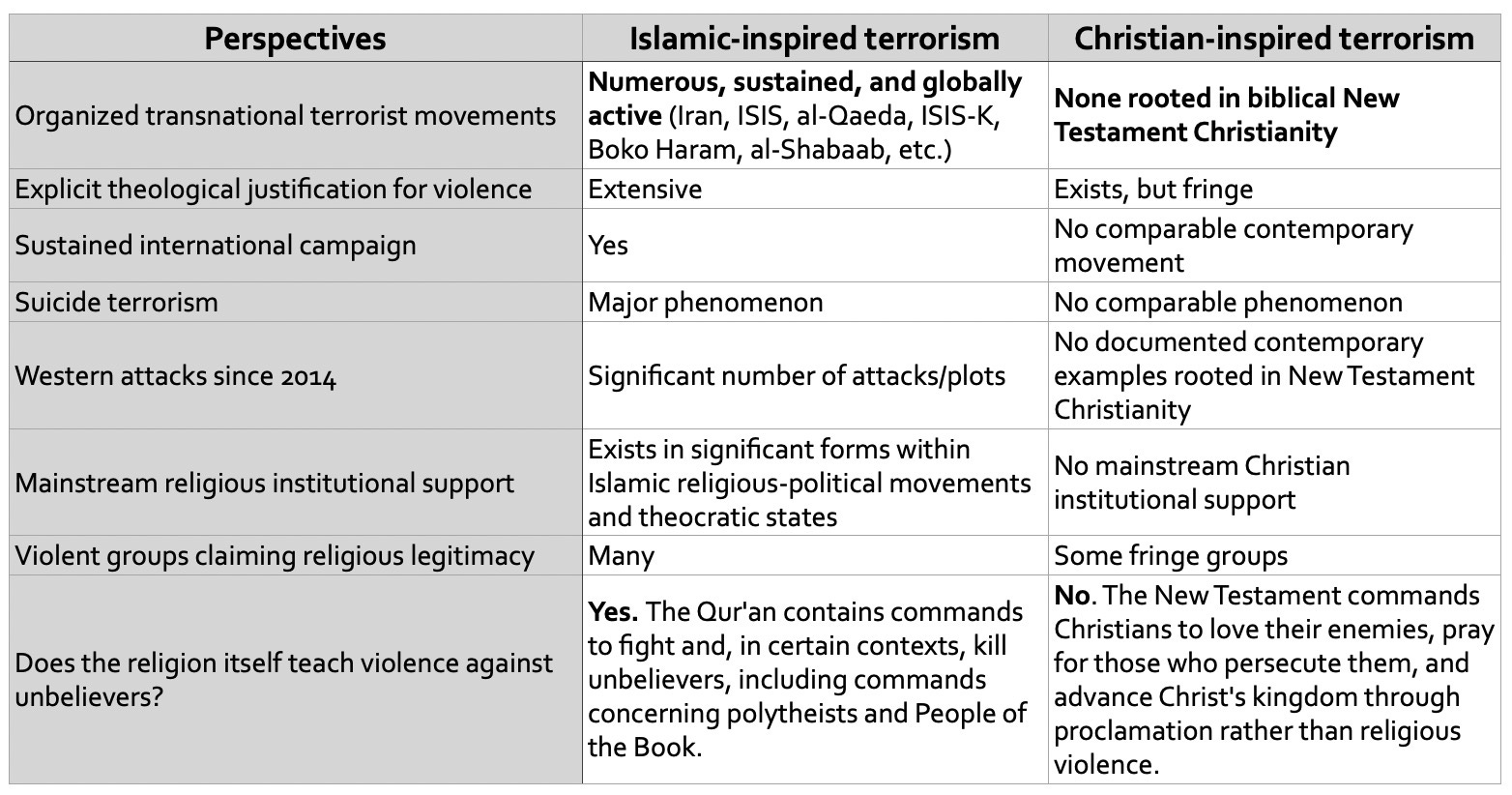
When we consider that Islam as a religion has seen religious-inspired, historical violence, and we have documented modern, recurring and international incidents of it, we return to this premise: Not all religions are equal, nor are all beneficial to all humanity.
The Slow Leak
I write from a Christian worldview and conviction. I write as a follower of Jesus. I urge grace and mercy as a foundation to relationships with all people, whether they share my religious beliefs or not.
However, I also write with urgency and a warning. As Islam has gained ground in many American cities and cultural centers, we’ve seen the inexorable movement and slow leak of Islam into the milieu of our culture. Three forces contributing to Islam’s growing influence are:
Satan. Any philosophy, worldview or religion that opposes Jesus as the Son of God and God incarnate is ultimately authored by the king of deception, Satan, whom Jesus described as “the father of lies.”4 The New Testament is clear on Jesus being the fulcrum of faith.
“We demolish arguments and every proud thing that is raised up against the knowledge of God, and we take every thought captive to obey Christ.” (2 Corinthians 10:4-5)
“But every spirit who does not confess Jesus is not from God. This is the spirit of the antichrist, which you have heard is coming; even now it is in the world.” (1 John 4:3)
Islamic religionists. There are documented Islamist movements that seek to reshape societies and governments according to Islamic law, pursuing that goal through electoral participation and other legal political means in the countries they’ve infiltrated or immigrated to. Other Islamist movements embrace violence to achieve similar religio-political ends.5 In other words, by vote or by violence, these Islamist religionists seek to subjugate societies, nations and cultures to Islam.
Captured cultural assets. As we observe western culture in this first quarter of the 21st century, we see more documented evidence of Islamic subjugation, insidious behind-the-scenes threatening of institutions, and outright terrorizing through intimidation and fear. Western media, academia, whole cities and even cultures have been infiltrated with Islamic militancy.
Consider the following:
UK grooming gangs: Investigations have documented decades of organized child sexual exploitation in several English towns, including Rotherham, where an estimated 1,400 children were abused between 1997 and 2013, predominantly by men of Pakistani heritage. The ethnic dimension of the abuse was repeatedly raised, yet authorities were reluctant to confront it. The investigations document systemic, institutional failure to respond adequately to the abuse.6
Southern Spain/Ceuta: In July 2026, an estimated 80,000 migrants crossed from Morocco into Spain’s North African enclave of Ceuta, overwhelming local authorities. Spanish prosecutors subsequently reported 23 sexual assaults, including nine involving children, following the influx.7
Dearborn, Michigan: Court cases and recent disputes have raised questions about religious neutrality and treatment of Christian evangelists in a city with a large Muslim population, including litigation over restrictions on Christian preaching at the Arab International Festival.8
Afghanistan: Since returning to power in 2021, the Taliban have imposed their interpretation of Islamic law, severely restricting women’s education, employment, movement, and religious freedom.9
Iran: Iran’s Islamic Republic constitutionally establishes Shi’a Islam as the state religion and requires legislation to conform to Islamic criteria, with religious minorities facing significant legal and governmental restrictions and strong persecution.10
Pakistan: Pakistan’s Islamic legal framework includes blasphemy laws and provisions that impose severe restrictions and criminal penalties based on religious belief and expression.11
These examples from around the world demonstrate oppression and repression. Closer to home, however, there are instances of intimidation in universities, in the media, in entertainment, and in government. The consistent strategy by Islamists is to paint Islam in a positive light and to discredit Judeo-Christian values and advocates of them.
The message is simple. Mock Muhammad and face the consequences. In September 2005, the Danish newspaper Jyllands-Posten published 12 cartoons depicting Muhammad. The most famous cartoon was drawn by Kurt Westergaard. It depicted Muhammad wearing a turban shaped like a bomb, with a lit fuse. That cartoon indeed lit a fuse. Demonstrations and riots occurred in numerous countries. Danish diplomatic facilities were attacked. Cartoonists and newspaper employees received death threats. Ten years later, Charlie Hebdo republished the Danish cartoons and then published its own Muhammad cartoons. In January 2015, Islamists attacked the magazine’s offices, killing 12 people.
Compare that behavior to Jesus’ teaching about those who oppose you:
“Love your enemies and pray for those who persecute you.” (Matthew 5:44)
Today, people can mock Jesus, ridicule Christianity, and even attack Christians. Biblical Christians are called to respond with compassion, prayer, and love for their enemies.
How then do we respond?
Years ago, I was required to read Faith Seeking Understanding: An Introduction to Christian Theology in seminary.12 In it, there are four imaginative dialogues between prominent thinkers to illustrate major theological debates. But the title has always grabbed me.
In today’s world, we must practice our faith while also seeking understanding. We must hold our culture as being anti-Islam at its very core. In Ross Douthat’s 2025 book Believe: Why Everyone Should Be Religious, Douthat takes Islam seriously as a world religion and argues that religious belief is preferable to secular indifference - believing in something is better than nothing.13 Yet Douthat also recognizes that Christianity and Islam make competing claims about revelation that cannot simply be harmonized. In a 2018 interview, he explained:
“If God's revelation to Muhammad were … as definitive a revelation as the revelations of Christianity and Judaism, I can't make that story work.”14
Press on, reader. Keep seeking understanding in your faith. And if you discover like millions of others that Islam (or other false religions that deny Jesus as Lord) don't make sense, seek deeper understanding and discover the joy, grace, and forgiveness found through faith in Jesus Christ.
The God of America is not Allah
Could the references to “God” in America’s history, founding documents, and architecture be interpreted as referring to some generic deity that would include the Islamic understanding of God? I don’t think so. It matters because we must ask which God we mean when we say that we are “under God” or that we “trust in God.”
Allah is the Arabic word for God, and Arabic-speaking Christians use the word. The theological question is therefore not whether Muslims believe in God. They do. The question is whether the God described in Islam is the God revealed in Scripture.
Christianity confesses one God in three persons: Father, Son, and Holy Spirit. Jesus Christ is God the Son incarnate. Islam explicitly rejects the Trinity, denies that Jesus is the divine Son of God, and denies the crucifixion and resurrection as Christianity understands them. These disagreements reach the very identity and nature of God.
Muslims have the same legal right to worship according to their conscience as other Americans. But religious liberty does not require Christians to regard Islamic and Christian claims about God as equally true. The two religions make fundamentally incompatible claims about who God is and what He has revealed about Himself.
America is one nation under God. That God is the biblical Christian/Jewish God. Yahweh. Christianity and Islam use overlapping language about God, but they do not mean the same thing by God.
Further Reading:
The Qur’an and the Christian: An In-Depth Look at the Book of Islam for Followers of Jesus, by Matthew Aaron Bennett (Grand Rapids, MI: Kregel Academic, 2022). Bennett is a PhD from Southeastern Baptist Theological Seminary and a missions/theology professor at Cedarville. He specifically warns Christians against assuming that apparent similarities between the Qur'an and Bible mean the two faiths are saying the same things.
Seeking Allah, Finding Jesus: A Devout Muslim Encounters Christianity, by Nabeel Qureshi (Grand Rapids, MI: Zondervan, 2014). I read it in 2017. I highly recommend it to anyone who needs perspective from a former Muslim on how finding Jesus changes a person’s entire perspective on life, love and eternal values.
Spain’s migrant surge reignites debate over Europe’s Islamist terror threat, by Benjamin Weinthal (Fox News: August 8, 2026)
Saving Faith: Making Religious Pluralism an American Value at the Dawn of the Secular Age, by David Mislin (Ithaca, NY: Cornell University Press, 2015)
A Brief History of the Pledge of Allegiance, by Robert Longley (ThoughtCo, updated June 10, 2025). Further irony related to our pledge is that the accompanying salute back in 1892 looked like the later Nazi salute:
When Francis Bellamy first wrote the Pledge in 1892, he and his editor at the Youth’s Companion magazine Daniel Sharp Ford agreed that its recitation should be accompanied by a non-military style hand salute. Ironically, the hand salute designed by Bellamy bore a striking similarity to what nearly 50 years later would become recognized as the extended hand “Nazi salute.”
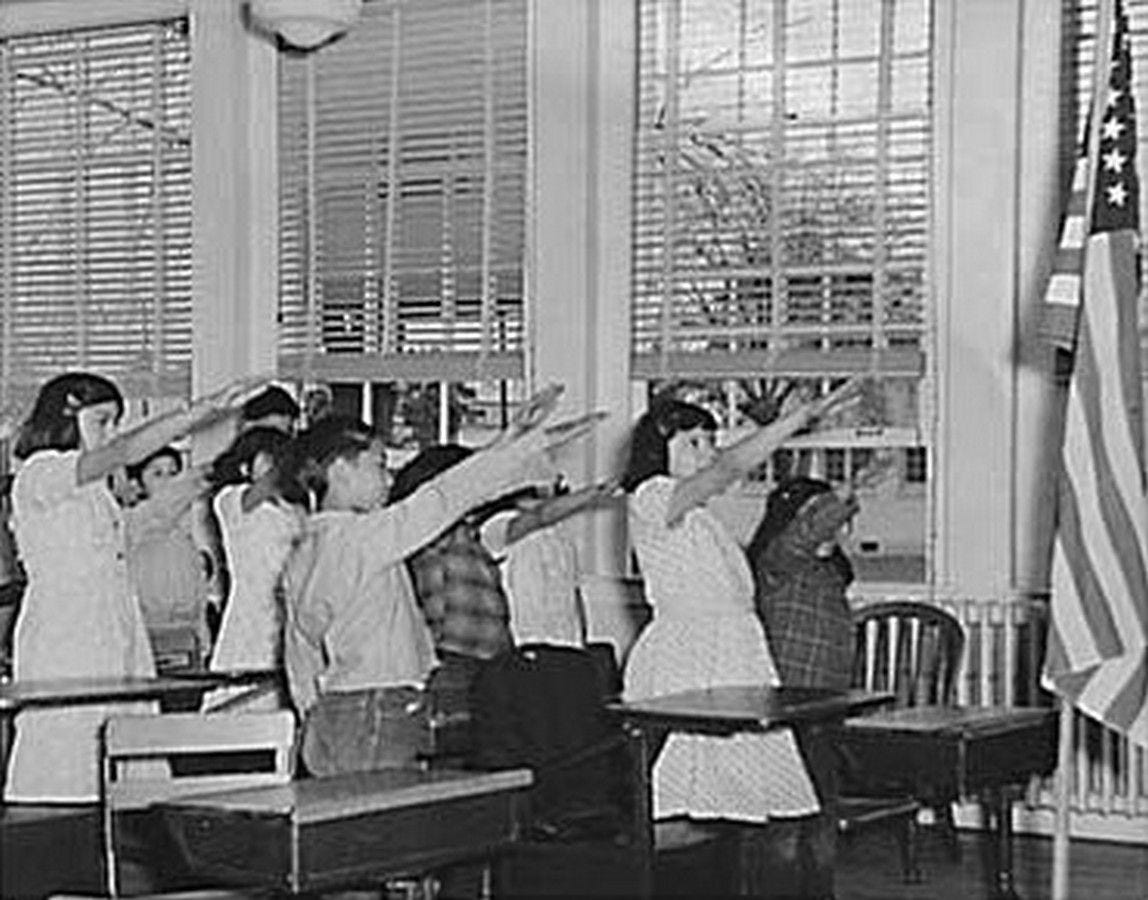
The so-called “Bellamy Salute” was used by schoolchildren across the nation when reciting the Pledge until the onset of World War II in 1939 when German and Italian fascists began using virtually the same salute as a sign of loyalty to Nazi dictators Adolf Hitler and Benito Mussolini.
Concerned that Bellamy’s salute could be confused for the hated “Heil Hitler!” salute and could be used to the Nazi’s advantage in war propaganda, Congress took action to eliminate it. On December 22, 1942, President Franklin D. Roosevelt signed a law specifying that the Pledge should “be rendered by standing with the right hand over the heart,” as it is today.
“You are of your father the devil, and you want to carry out your father’s desires. He was a murderer from the beginning. He does not stand in the truth, because there is no truth in him. When he tells a lie, he speaks from his own nature, because he is a liar and the father of lies.” (John 8:44)
Islamist Parties and Democracy: Three Kinds of Movements, by Tamara Cofman Wittes (Washington, DC: Brookings Institution, July 31, 2008)
National Audit on Group-based Child Sexual Exploitation and Abuse, by UK Government (London: Home Office, 2025)
Sexual assaults happening almost every day in Ceuta, prosecutors say, by Paul Kirby (BBC News, September 1, 2026)
Dearborn Leaders Spent Taxpayer Funds to Promote Islam While Discriminating Against Christians and Jews, Lawsuit Alleges, by Brittany Bernstein (National Review, September 17, 2026)
Also see:
Docs Show How Dearborn’s Muslim Leaders Make It A ‘Hostile Place For Christians And Jews’, by M.D. Kittle (The Federalist, September 25, 2025)
Religious Freedom Eradicated in Afghanistan, by U.S. Commission on International Religious Freedom (August 27, 2025).
Iran’s Brutal Religious Persecutions, by Doug Bandow (Cato Institute, February 3, 2026)
World Report 2025: Pakistan, by Human Rights Watch (New York: Human Rights Watch, 2025)
Faith Seeking Understanding, Fourth ed.: An Introduction to Christian Theology, by Daniel L. Migliore (Grand Rapids, MI: William B. Eerdmans Publishing Company, 2023)
Believe: Why Everyone Should Be Religious, by Ross Douthat (New York, NY: Sentinel, 2025)
Ross Douthat on Narrative and Religion (Ep. 32, Live at Mason), by Tyler Cowen, featuring Ross Douthat (Conversations with Tyler, January 17, 2018)