

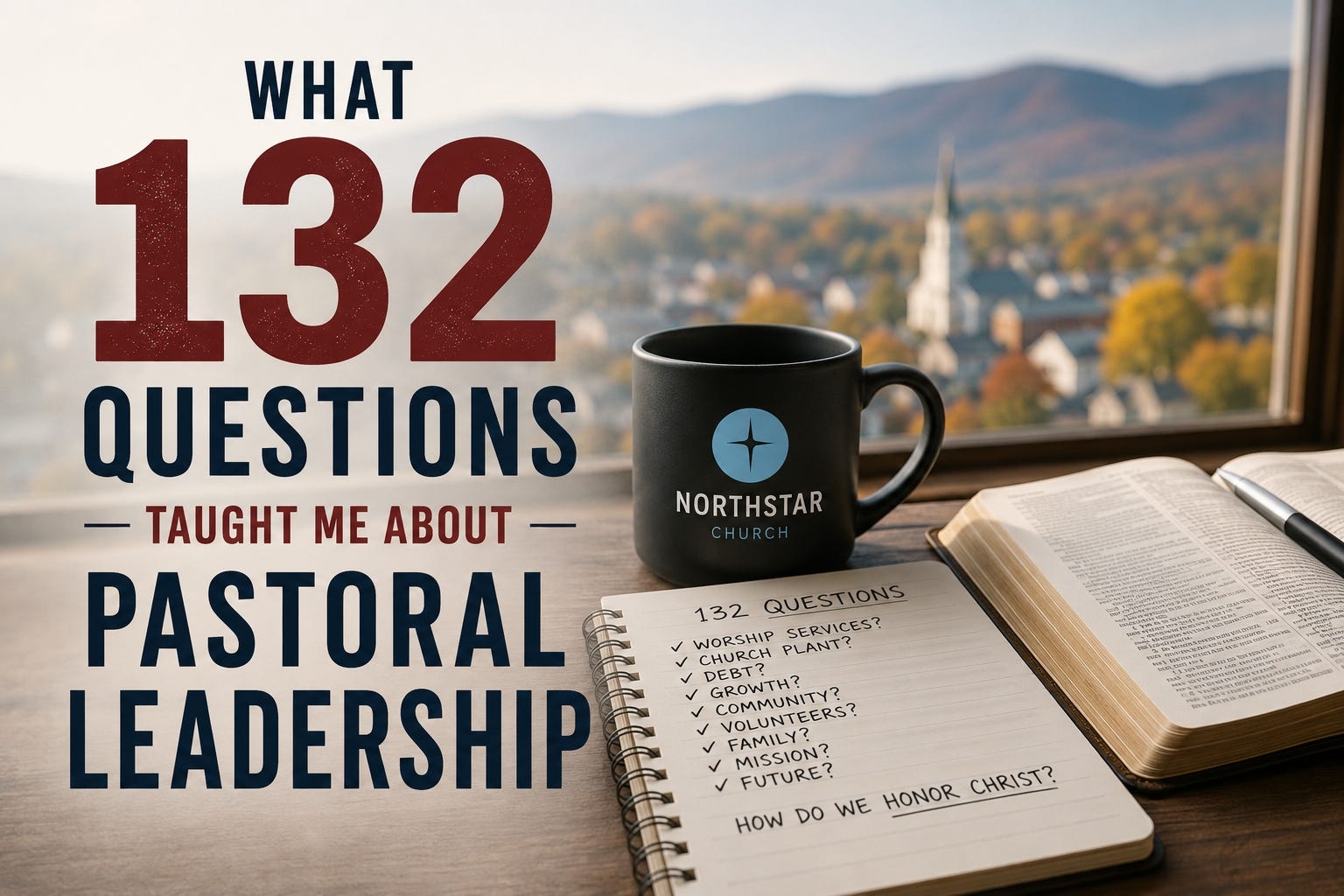
I thought I was writing an FAQ with the help of AI. Instead, the project became an unexpected opportunity for discipleship - first for me, then for our church.
Our church is in a season of protracted, unpredictable and unprecedented growth. We are nestled in the foothills of the Appalachian Mountains. Blacksburg is home to Virginia Tech. Over our church’s 20+ year history, we've enjoyed a significant ministry with and to young adults.
In 2021 we moved into our first church facility. We’d met in Blacksburg Middle School for 18 years before the pandemic response kicked us out.1 Since moving in, our growth rate has been exciting and challenging. We never thought we’d be in the position of needing to make expansion decisions five years later.
This year, I’ve led our church to consider a “Trinity of Strategy.” We’ve been in a season of prayer as we consider:
Church planting
Adding additional worship services
Building options
At our May Member Meeting, we presented these topics to our members and asked them for questions and concerns. Each table collected their questions, and when we tallied them after the meeting, there were 132 submitted questions! Our pastoral staff had committed to responding to them at our July Member Meeting. Whew!
Responding to 132 questions
My original plan was straightforward: write an FAQ so everyone would have answers. One of our pastors helpfully observed that many questions were duplicates, and as he grouped them according to the trinity above, several main themes in the questions became apparent.
I began writing. After about three pages, I realized the document was becoming pretty lengthy. Although I was answering questions, I began to wonder if I was really responding to members’ concerns. I found myself wanting to shepherd and teach even as I answered. An FAQ began to morph into an opportunity for discipleship.
Curious what I might be missing, I uploaded the questions and my draft responses into AI. I expected help organizing the material. Instead, it challenged how I was thinking about the questions themselves.
Questions like:
Why are we adding another service?
Why are we considering a church plant?
Why would we ever take on debt?
Will our church still feel like family if we keep growing?
At first, those questions appeared to require practical answers. Some of them even triggered an emotional (and if I’m honest, indignant) response. AI treated them at face value and challenged me to think deeper. As I began thinking and praying through them, I realized we had an opportunity as leaders to approach our responses from a deeper and more strategic level.
The questions themselves weren’t difficult because people were skeptical or distrustful. They reflected the sincere desire of thoughtful church members. We’d asked them to ask questions, after all. They wanted to understand how their leaders were thinking. Their questions revealed that they needed to “see” the hours of prayer, the conversations among our elders, the study of scripture, the discussions with leaders in various fields, and the countless moments when our leaders stopped to ask, “What do we sense God leading us to do? How can we grow forward faithfully?” The FAQ became an opportunity to pull back the curtain and invite our church members into leadership conversations.
Every question had another question beneath it.
Through give and take with AI over hours and days of writing and research, one of the most valuable discoveries was realizing that very few questions were limited to the subject they mentioned. A question about adding another worship service often reflected concern for volunteers. Questions about buildings became conversations about ministry philosophy. Questions about debt led to broader discussions of stewardship, faith, and mission. Questions about church growth reminded me that today’s classroom challenges are evidences of our members “being the church” bearing fruit.
As I worked through the questions, I found myself asking different questions in return. Why are we making this decision? What biblical principles are shaping it? How can this answer do more than provide information? Practical questions often expose theological convictions, and helping people understand those convictions is one of the privileges of pastoral ministry. I’ve been guilty in my ministry of too often answering a question quickly instead of allowing it become a discipleship opportunity.
AI Didn’t Write My Theology
This project was the first major writing project in which I intentionally incorporated AI throughout the editing process. I didn’t ask it to tell me what to believe or to write my theology. In fact, I constantly had to redirect, offer scriptural insight and challenge some conclusions. But I also read its responses and processed them.
I found myself using AI much like a research assistant or editor. It organized 132 submitted questions, identified recurring themes, pointed out repetition, suggested smoother transitions, and surfaced patterns that I might otherwise have overlooked. It was truly helpful in the rabbit trails that certain questions led me down.
The work itself remained deeply pastoral. Prayer, scripture, theological reflection, research, conversations with our pastors and elders, and careful editing all remained at the center of the process. AI simply accelerated the organizational work, giving me more time and mental energy to wrestle with the questions that mattered most and to communicate more clearly.
Each time I returned to the document (the project was several days), I was humbled anew by the engagement and interest that 132 questions from our members revealed. Our church cares about the mission of Jesus. It cares about its leaders and volunteers.
The lesson I’ll carry forward
I finished the project with 18 pages of material. Yeesh. I knew that many of our members wouldn’t read such a long of a document, so I had AI help me produce an attractive one-page document that summarized the questions. Each group of responses to the Trinity of Strategy referenced the page numbers on the larger document. When I sent the email to members with responses, I urged members to “find their question” and read its longer response in the full FAQ.
Looking back, I am still amazed at the helpfulness of AI. The greatest lesson wasn’t about AI, however. My main takeaway was the importance of not simply answering questions. Leadership doesn’t provide quick answers. Good leadership invites us to ask better questions. Jesus modeled that throughout His ministry. He consistently responded to questions or conflicts with a question of His own. Jesus’ questions invited people to examine their hearts, challenge their assumptions, and think more deeply about the truth.
I’m grateful our members engaged with us. Their curiosity, concerns and questions led me down a personal growth path. The process reminded me that nearly every practical issue in the life of the church presents an opportunity to help God’s people think more biblically and to point them back to Christ. I still believe church members deserve clear answers. But this experience reminded me that the best answers often begin with better questions. Every question about budgets, buildings, worship services, or strategy ultimately becomes an opportunity to point people toward Christ. Looking back, that may have been the greatest gift hidden inside those 132 questions.
A Final Thought
As I reflected on this project, I found myself wondering what others might take away from the experience.
Pastors
Invite your church to ask questions.
You’ll quickly discover where your communication could be clearer. More importantly, if you’ll prayerfully consider not only the questions themselves but also what lies beneath them, you’ll likely find every question becoming:
A discipleship opportunity
A leadership growth opportunity
Some of the greatest lessons in pastoral ministry don’t come from answering questions. They come from wrestling with them.
Church Members
Think about the questions you would ask your pastors. Then ask yourself another question: Why am I asking this? What assumptions, hopes, fears, or expectations lie beneath it?
Sometimes discovering the motivation behind a question is just as valuable as finding its answer. That kind of reflection doesn’t simply lead to greater understanding of your church’s leadership. It often leads to greater understanding of your own heart.
What’s next?
I’d love to hear any comments below, and as always, please hit those subscribe or share buttons in this post!
You can read more about our church journey here:
10 years of ministry (and lots of coffee)

This July I celebrated ten years of ministry at Northstar Church. Time has flown. It is my longest tenure of any ministry/job I've ever had. It's been rewarding, challenging, growing, encouraging, an…
Wow , This is soooooo good, your church and mine are going through very similar seasons of church growth right now, we already added one phase of an addition, a new bigger sanctuary, and now we are nearly done with phase two, which is a huge classrooms, and childrens wing. We have biblical counseling conferences every Fall and Spring which have grown quickly with attendance, and have more and more young families attending, with many children. So this blog resenated with me a lot.. So much wisdom in how you and your elders have approached church growth and included your congregation. Im praying for you and your elders as you go through this season of church growth. and the need for additional room. May God reveal to you every step you need to take. God bless,,, love and prayer, Jamie